
 | |  | |  | |  | |  | |  |


Cali was born Sept 14, 2010. Sweet but a little shy with strangers. Would probably prefer a
quieter house with mature people & even another dog to play with.
Contact us at rufflabs@caltel.com
This is a Dark yellow female. "She grew too fast" as a pup and has developed an abnormality in the
cartilage-to-bone transformation in her back legs called osteochondrosis. When I read up on this diagnosis from the
vet, it says if it occurs it will show up in pups between 4 & 6 months of age.
Pieces of excess cartilage were breaking off & rubbing between the joints causing pain when she was 4 months old.
Which caused her to start limping when she ran around in my big yard for a long time. She seems to have grown out
of this issue now. So I am looking for a good home for her, but not a large busy family. She would also love to be an
inside dog. She loves to be with someone or another calm dog.
quieter house with mature people & even another dog to play with.
Contact us at rufflabs@caltel.com
This is a Dark yellow female. "She grew too fast" as a pup and has developed an abnormality in the
cartilage-to-bone transformation in her back legs called osteochondrosis. When I read up on this diagnosis from the
vet, it says if it occurs it will show up in pups between 4 & 6 months of age.
Pieces of excess cartilage were breaking off & rubbing between the joints causing pain when she was 4 months old.
Which caused her to start limping when she ran around in my big yard for a long time. She seems to have grown out
of this issue now. So I am looking for a good home for her, but not a large busy family. She would also love to be an
inside dog. She loves to be with someone or another calm dog.

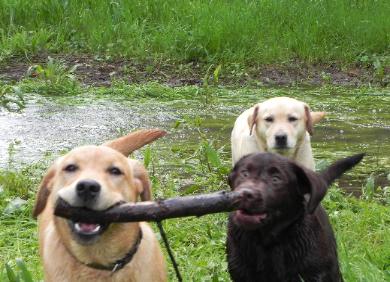


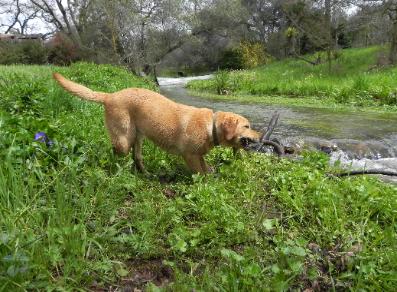


Cali was born Sept 14, 2010. Sweet but a little shy with strangers. Would probably prefer a
quieter house with mature people & even another dog to play with.
Contact us at rufflabs@caltel.com
quieter house with mature people & even another dog to play with.
Contact us at rufflabs@caltel.com
This is a 9 month old Dark yellow female. "she grew too fast" and has developed an abnormality in the
cartilage-to-bone transformation in her back legs called osteochondrosis. When I read up on this diagnosis from the
vet, it says if it occurs it will show up in pups between 4 & 6 months of age.
Pieces of excess cartilage break off & rub between the joints causing pain when running. Which cause her to limp
when she runs around in my big yard for a long time. So she could be free to a quiet home with possibly older
people, but not to a busy family. She would also love to be an inside dog. She loves to be with someone or another
calm dog. The Vet said she may grow out of it.
-----------------------------------------------------
Below is some info on this issue that I found on some of the links I read.
Exercise Control Restricting the amount and intensity of a puppy's activity
has been shown to reduce the incidence of osteochondrosis (OCD). Flaps of
cartilage that have not yet broken away from their underlying bone may heal
back if the affected joint use is not too intense or prolonged. All large
breed puppies should participate in only regular short walks until they have
finished growing; this recommendation is particularly important if the dog
already has osteochondrosis. Dogs with osteochondrosis (OCD) should be
restricted to the leash and given a maximum of three short (10 - 15 minute)
walks per day.
Dietary Restriction Overfeeding contributes significantly to the development
of many orthopedic conditions in dogs, including osteochondrosis (OCD). If
your dog has osteochondrosis (OCD), you should discontinue administration of
any vitamin or mineral supplements unless specified by your veterinarian.
(Consult your veterinarian about an appropriate dog food to give your pet.)
Many dogs that develop osteochondrosis (OCD) are the healthiest-looking,
largest and fastest growing in their litter; these are the dogs that managed
to push out the litter mates from the feeding bowl and are growing too
rapidly for the strength of their physical structure.
Reduce your dog's total calorie intake to that recommended by the feed company and
your veterinarian. Since many of pets with osteochondrosis have experienced
rapid growth, some veterinarians feel that feeding lower protein diets
without supplements may be helpful in decreasing the incidence of the
disease. Discuss feeding issues with your veterinarian.
--------
What is osteochondrosis (OCD)?
Osteochondrosis (also known as OCD) is a common, painful disease in dogs. It
is characterized by an abnormality in the cartilage-to-bone transformation.
As a result, cartilage and bone fragments may break off into the joint
space. Osteochondrosis is not a form of arthritis, however, it often leads
to arthritis. Larger breeds of dog have a genetic predisposition towards the
condition, which results from rapid growth. (The pain from osteochondrosis
is similar to the "growing pains" experienced by adolescents.)
Cartilage is the tissue, normally at the ends of long bones, which
contributes to pain-free motion. Osteochondrosis is a congenital defect in
normal joint cartilage development that leads to the development of a loose
piece or flap of cartilage. This loose piece or flap can give rise to
secondary degenerative joint disease. Secondary degenerative joint disease
that develops as a result of osteochondrosis, generally occurs early in the
dog's life as opposed to the "wear and tear" arthritis that many dogs
experience later in life.
Areas most commonly affected by osteochondrosis include the shoulder, elbow,
knee (stifle) and ankle (hock) in young dogs. Osteochondrosis can occur on
both sides (bilateral) and may involve several joints. There are several
types of osteochondrosis.
Types of osteochondrosis
Conditions that affect the forelimbs include osteochondritis dessicans (OD)
of the elbow or shoulder, fragmented coronoid process (FCP), and ununited
anconeal process (UAP). When the elbows are affected, these conditions are
often referred to as simply "elbow dysplasia." Osteochondrosis affecting the
hind limbs is less common.
Osteochondritis dissecans (OD) occurs at the surface of a joint when a
thickened area of cartilage develops, loosely attached to the underlying
bone. This thicker cartilage may crack and cause a flap of cartilage to
break away. When this cartilage flap falls into a certain position, your pet's
discomfort will be minimal but, as it shifts position, pain and joint
swelling become acute. OD of the elbow and shoulder usually occurs between
four and seven months of age. Breeds most commonly affected include the
Goldens, Labradors, and other retrievers and (less frequently) the
rottweiler.
Fragmented coronoid process (FCP) of the elbow joint is the most common and
severe type of osteochondrosis, affecting a dog's forelimbs. Two bones, the
radius and the ulna, run the distance from your pet's elbow to wrist. FCP
results from either a) abnormal development of the cartilage in an area of
the ulna known as the "coronoid process," or b) abnormal length of the
radius and ulna bones. Between four and six months of age, a small piece of
the coronoid process may fragment inside the elbow leading to early onset
secondary arthritis. (This usually develops between five and ten months of
age.) Goldens, Labradors, other retrievers, rottweilers and Bernese mountain
dogs commonly experience FCP.
Ununited anconeal process (UAP) is a failure of the growth center of the
"anconeal process" (located in your pet's elbow joint), to unite properly
with the ulna. This fusion should be completed by 16 to 24 weeks of age. The
ununited anconeal process is a large piece of bone connected to the ulna by
a strand of fibrous tissue. It causes joint instability which may lead to
severe secondary degenerative arthritis. UAP disease has been reported in
most large breeds, particularly German shepherds and St. Bernards. UAP has
also been reported in breeds with short, curved legs such as the basset
hound. Your pet may not exhibit signs of UAP until the secondary
degenerative joint disease begins to make itself known.
OCD in the stifle (knee) joint Osteochondrosis in the stifle can be
difficult to diagnose, as the lameness is frequently obscure and is often
confused with the gait of canine hip dysplasia (CHD).
OCD in the hock (ankle) joint Affected pets are usually four to five months
of age and exhibit slight lameness of the hind limbs. The ankle joints
appear straight and swollen and are painful on movement. X-rays show
cartilage and bone fragments and bone spurs due to secondary degenerative
joint disease.
cartilage-to-bone transformation in her back legs called osteochondrosis. When I read up on this diagnosis from the
vet, it says if it occurs it will show up in pups between 4 & 6 months of age.
Pieces of excess cartilage break off & rub between the joints causing pain when running. Which cause her to limp
when she runs around in my big yard for a long time. So she could be free to a quiet home with possibly older
people, but not to a busy family. She would also love to be an inside dog. She loves to be with someone or another
calm dog. The Vet said she may grow out of it.
-----------------------------------------------------
Below is some info on this issue that I found on some of the links I read.
Exercise Control Restricting the amount and intensity of a puppy's activity
has been shown to reduce the incidence of osteochondrosis (OCD). Flaps of
cartilage that have not yet broken away from their underlying bone may heal
back if the affected joint use is not too intense or prolonged. All large
breed puppies should participate in only regular short walks until they have
finished growing; this recommendation is particularly important if the dog
already has osteochondrosis. Dogs with osteochondrosis (OCD) should be
restricted to the leash and given a maximum of three short (10 - 15 minute)
walks per day.
Dietary Restriction Overfeeding contributes significantly to the development
of many orthopedic conditions in dogs, including osteochondrosis (OCD). If
your dog has osteochondrosis (OCD), you should discontinue administration of
any vitamin or mineral supplements unless specified by your veterinarian.
(Consult your veterinarian about an appropriate dog food to give your pet.)
Many dogs that develop osteochondrosis (OCD) are the healthiest-looking,
largest and fastest growing in their litter; these are the dogs that managed
to push out the litter mates from the feeding bowl and are growing too
rapidly for the strength of their physical structure.
Reduce your dog's total calorie intake to that recommended by the feed company and
your veterinarian. Since many of pets with osteochondrosis have experienced
rapid growth, some veterinarians feel that feeding lower protein diets
without supplements may be helpful in decreasing the incidence of the
disease. Discuss feeding issues with your veterinarian.
--------
What is osteochondrosis (OCD)?
Osteochondrosis (also known as OCD) is a common, painful disease in dogs. It
is characterized by an abnormality in the cartilage-to-bone transformation.
As a result, cartilage and bone fragments may break off into the joint
space. Osteochondrosis is not a form of arthritis, however, it often leads
to arthritis. Larger breeds of dog have a genetic predisposition towards the
condition, which results from rapid growth. (The pain from osteochondrosis
is similar to the "growing pains" experienced by adolescents.)
Cartilage is the tissue, normally at the ends of long bones, which
contributes to pain-free motion. Osteochondrosis is a congenital defect in
normal joint cartilage development that leads to the development of a loose
piece or flap of cartilage. This loose piece or flap can give rise to
secondary degenerative joint disease. Secondary degenerative joint disease
that develops as a result of osteochondrosis, generally occurs early in the
dog's life as opposed to the "wear and tear" arthritis that many dogs
experience later in life.
Areas most commonly affected by osteochondrosis include the shoulder, elbow,
knee (stifle) and ankle (hock) in young dogs. Osteochondrosis can occur on
both sides (bilateral) and may involve several joints. There are several
types of osteochondrosis.
Types of osteochondrosis
Conditions that affect the forelimbs include osteochondritis dessicans (OD)
of the elbow or shoulder, fragmented coronoid process (FCP), and ununited
anconeal process (UAP). When the elbows are affected, these conditions are
often referred to as simply "elbow dysplasia." Osteochondrosis affecting the
hind limbs is less common.
Osteochondritis dissecans (OD) occurs at the surface of a joint when a
thickened area of cartilage develops, loosely attached to the underlying
bone. This thicker cartilage may crack and cause a flap of cartilage to
break away. When this cartilage flap falls into a certain position, your pet's
discomfort will be minimal but, as it shifts position, pain and joint
swelling become acute. OD of the elbow and shoulder usually occurs between
four and seven months of age. Breeds most commonly affected include the
Goldens, Labradors, and other retrievers and (less frequently) the
rottweiler.
Fragmented coronoid process (FCP) of the elbow joint is the most common and
severe type of osteochondrosis, affecting a dog's forelimbs. Two bones, the
radius and the ulna, run the distance from your pet's elbow to wrist. FCP
results from either a) abnormal development of the cartilage in an area of
the ulna known as the "coronoid process," or b) abnormal length of the
radius and ulna bones. Between four and six months of age, a small piece of
the coronoid process may fragment inside the elbow leading to early onset
secondary arthritis. (This usually develops between five and ten months of
age.) Goldens, Labradors, other retrievers, rottweilers and Bernese mountain
dogs commonly experience FCP.
Ununited anconeal process (UAP) is a failure of the growth center of the
"anconeal process" (located in your pet's elbow joint), to unite properly
with the ulna. This fusion should be completed by 16 to 24 weeks of age. The
ununited anconeal process is a large piece of bone connected to the ulna by
a strand of fibrous tissue. It causes joint instability which may lead to
severe secondary degenerative arthritis. UAP disease has been reported in
most large breeds, particularly German shepherds and St. Bernards. UAP has
also been reported in breeds with short, curved legs such as the basset
hound. Your pet may not exhibit signs of UAP until the secondary
degenerative joint disease begins to make itself known.
OCD in the stifle (knee) joint Osteochondrosis in the stifle can be
difficult to diagnose, as the lameness is frequently obscure and is often
confused with the gait of canine hip dysplasia (CHD).
OCD in the hock (ankle) joint Affected pets are usually four to five months
of age and exhibit slight lameness of the hind limbs. The ankle joints
appear straight and swollen and are painful on movement. X-rays show
cartilage and bone fragments and bone spurs due to secondary degenerative
joint disease.


